Abstract Software
Session Builder and Scheduling


.svg)





How many hours did your team spend wrestling with disjointed spreadsheets and endless email threads during your last awards cycle? For most program administrators in association and higher education, the answer is far too many.
Managing an awards program, scholarship, or grant process means juggling a lot of moving parts — but it shouldn’t feel this way. A dedicated, all-in-one application management platform brings structure to your entire evaluation process. It keeps critical data securely organized for your busy administrators, while remaining straightforward and stress-free for your volunteer judges to navigate.
Here is your step-by-step guide to mastering the competition judging process:
Whether you’re scoring your first scholarship cycle or improving a well-established grant program, this guide will help you take back control and streamline your entire review process. Let’s get started!

Competition judging is the systematic process of evaluating applications or nominations for institutional awards, grants, scholarships, or academic abstracts by a dedicated committee of reviewers.
The cycle involves several key stages:
The primary goal of competition judging is to conduct a fair, consistent, and transparent assessment that accurately identifies the most deserving candidates or award recipients.
Fair judging starts with consistency. Standardized scoring rubrics, structured evaluations, and proper judge training all work together to minimize bias. When you define clear criteria and build them directly into a rubric, automated multi-round interviews can enforce that rubric across your entire panel by averaging out individual scoring variances and preventing arbitrary outcomes.
Customizable submission forms also play a key role. When every applicant answers the same baseline questions, every candidate can receive equitable consideration. Providing comprehensive judge training materials often reduces unconscious bias across your committee as well.

Competition judging software is technology that handles the back-end evaluation of awards, grants, and scholarships—and often also manages front-end submissions. It automatically collects applications, verifies eligibility, manages the entire judging workflow, and calculates scores in easy-to-use dashboards.
The best competition judging platforms eliminate duplicate data entry across siloed departments, integrate with your AMS or CRM software, and include built-in communication tools and opportunities for digital winner recognition. Additionally, security measures should ensure sensitive applicant data stays protected and your organization stays compliant.
Here is a quick comparison between conducting competition judging with spreadsheets and having a dedicated quality platform:
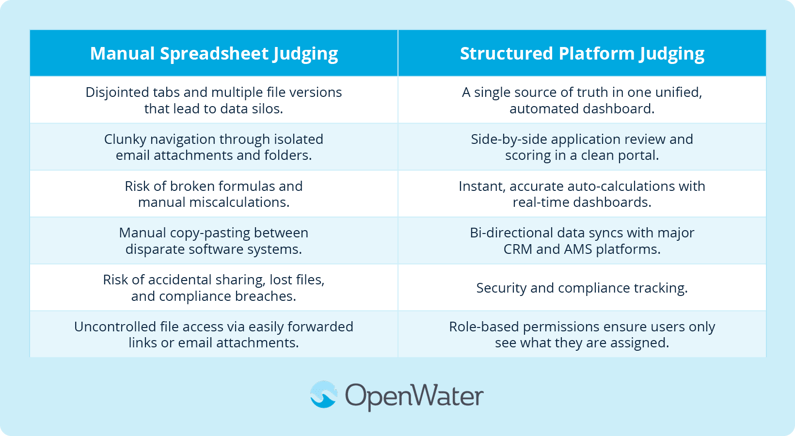
Setting up a strong competition judging process means defining clear metrics and putting a dedicated platform to work. With a standardized rubric and automated multi-round reviews, your team can average out scoring variances and determine winners—confidently, without the manual chaos.
Before you open submissions, define what makes a candidate successful. Outlining your program goals upfront gives every applicant and reviewer a firm baseline to work from.
Reviewing data from your previous evaluation cycles will help your team establish realistic and actionable goals for upcoming applications. When you analyze historical submission trends rapidly highlights areas where minor criteria adjustments might significantly improve incoming applicant quality. From there, you can begin:
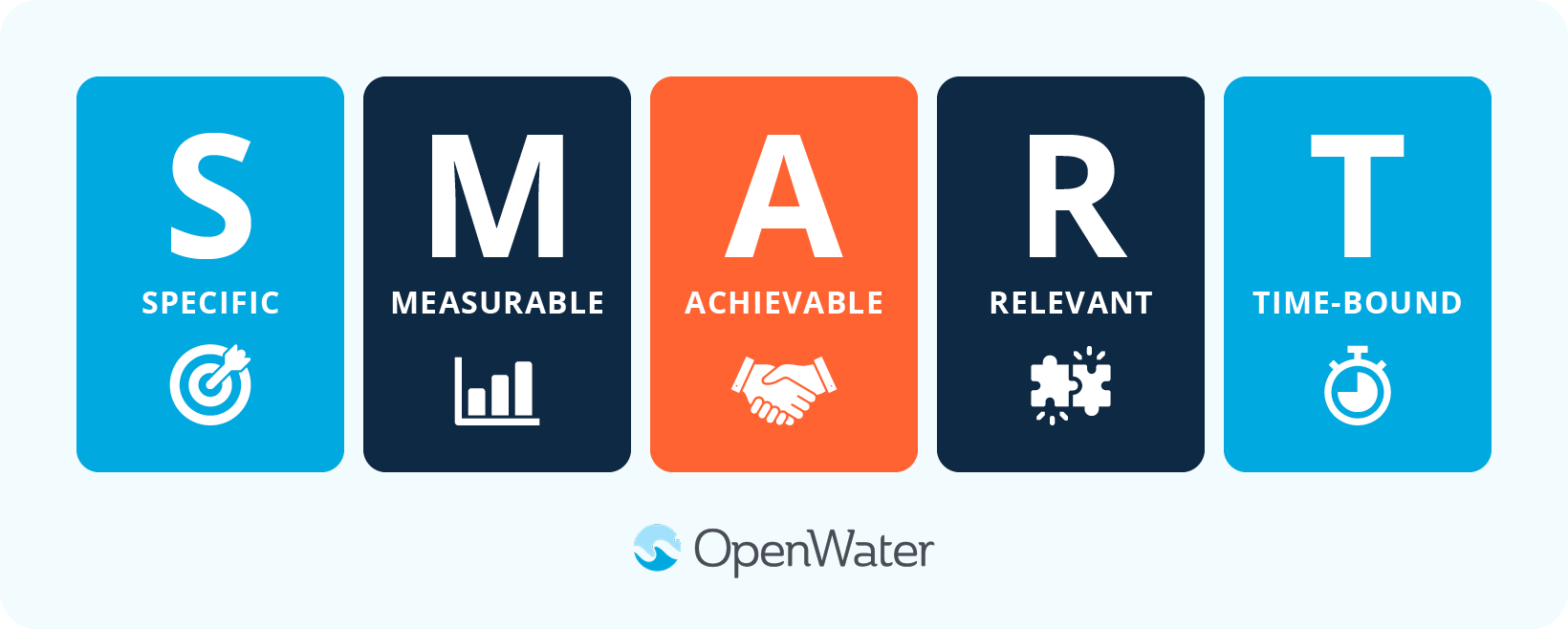
Before launching your awards program, use the SMART framework to establish clear, actionable goals that will drive your cycle’s success. This means your goals should be:
A well-built rubric is the backbone of fair competition. Define clear, uniform metrics and build them directly into your review platform so every submission is measured against the same standards. Your rubric should:
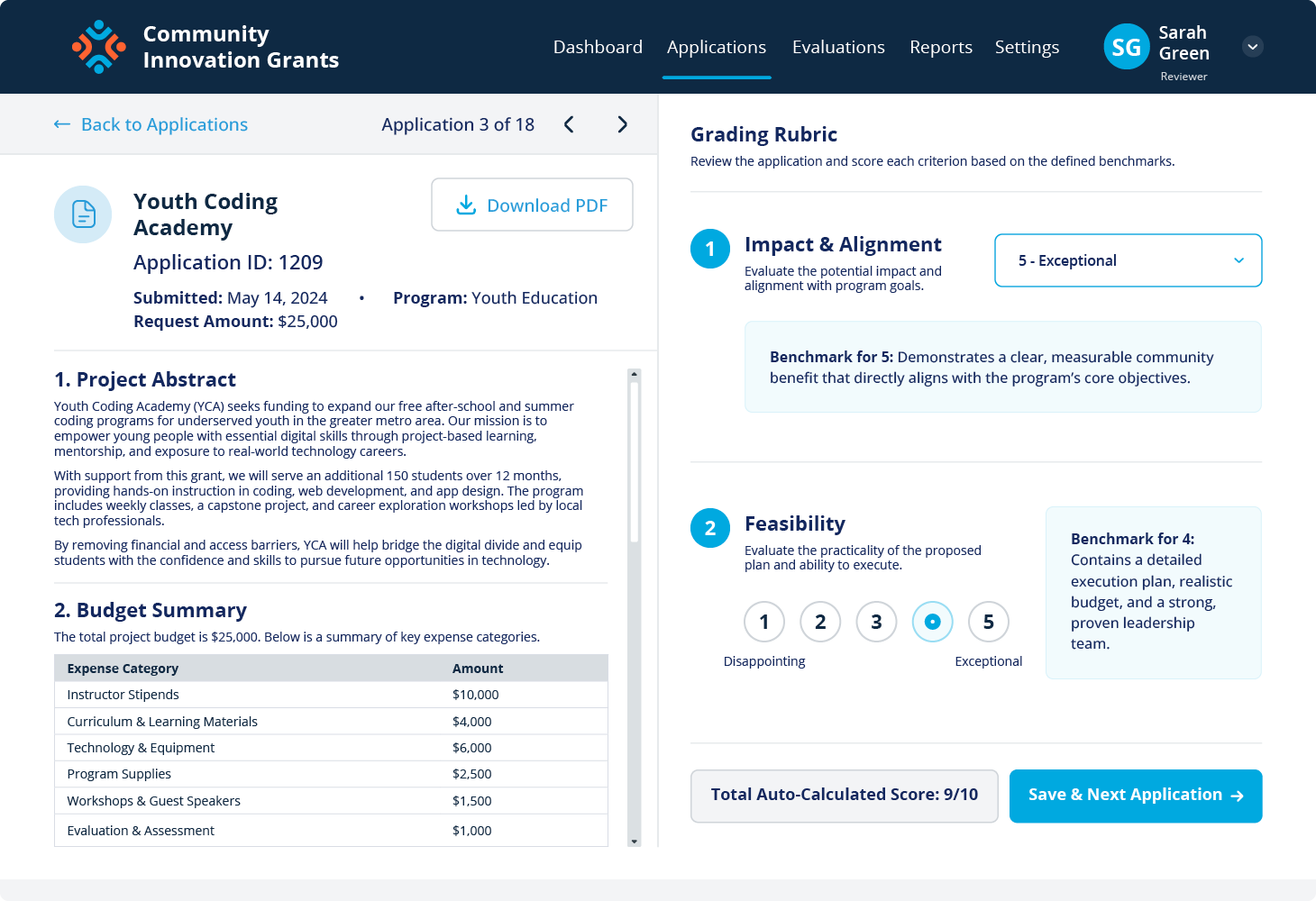
Before you invite your volunteer judges to dive in, run a quick pilot test with your internal team. This test can help you pinpoint confusing language, unclear definitions, and potential roadblocks before they reach your reviewers, making the process as smooth as possible once it starts.
Once your rubric is set, recruit reviewers with the right expertise to evaluate the submissions accurately. Proper internal vetting keeps the evaluation process credible from start to finish. Strategically assemble a group of recognized experts, and try to build a panel with diverse professional and personal backgrounds to make your review process more balanced.
Maintaining an updated database of reliable past reviewers makes future recruitment far easier. Recognize and reward your best volunteers and team members—it goes a long way toward keeping them engaged.
Multi-round review automatically routes each submission to multiple judges. Centralizing this workflow inside a secure platform eliminates the administrative fatigue that comes with manual data distribution.
Set clear deadlines for judges to review their assigned submissions, and automate reminder emails to ensure they’re met. Progress dashboards give administrators a real-time view of where things stand—making it easy to spot bottlenecks and reassign submissions before they stall.
Once all scores are in, your next steps are to:
Additionally, archive your scoring data to ensure you can explain your decisions if questions arise and so you can review it as you plan future competitions.
Choosing the right competition judging software can be the critical factor in setting your awards, grant, or scholarship program up for both short- and long-term success. OpenWater automates multi-round reviews and enforces standardized scoring so your team can manage complex workflows with minimal administrative headaches.
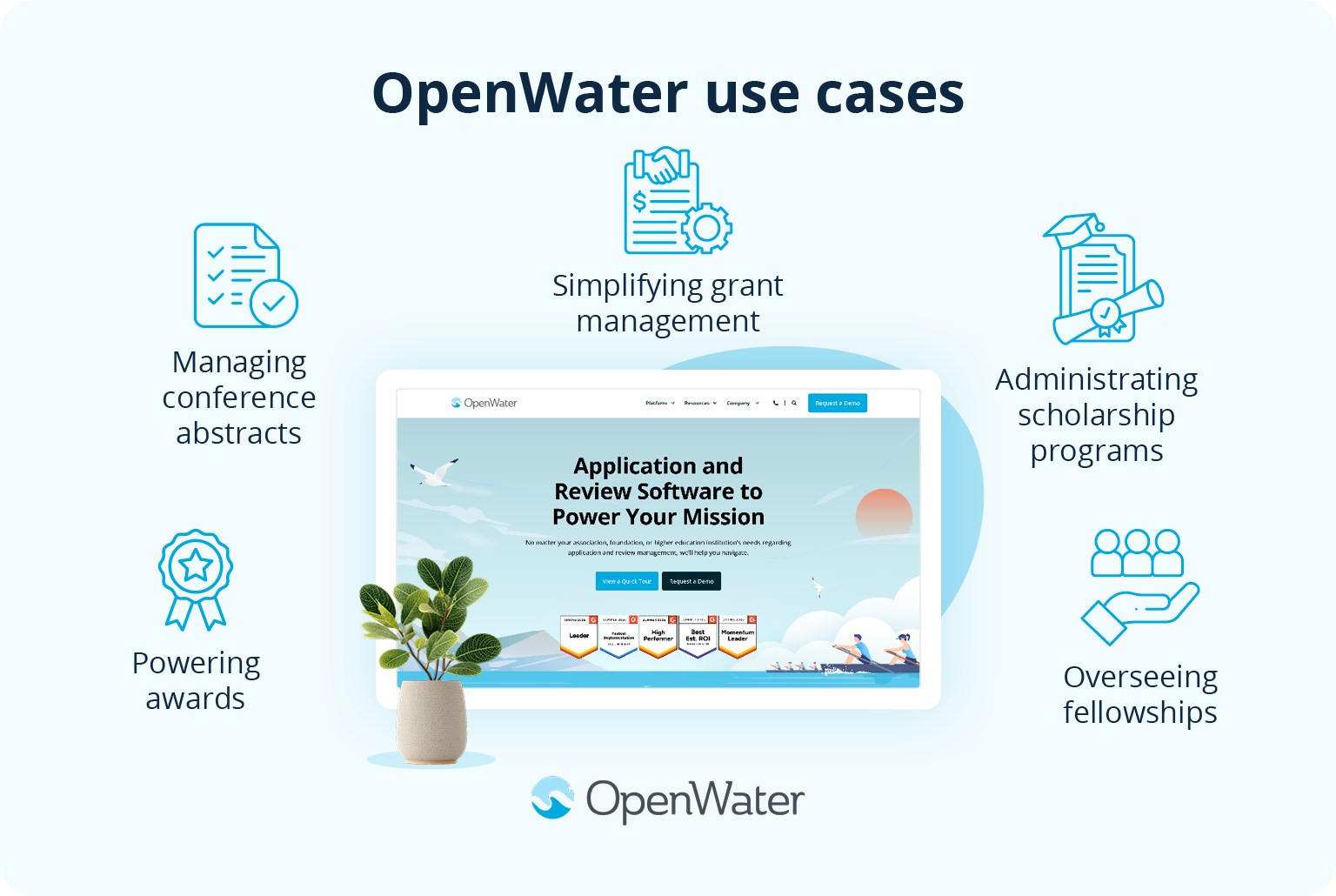
More than 750 associations, higher education institutions, and foundations trust OpenWater to manage competition judging and deliver positive results. Between our top-of-the-line platform and our support team's commitment to your success, you'll be well-equipped to take your next contest from good to great.
A structured digital infrastructure transforms competition judging from a stressful scramble into a smooth, repeatable operation. Prioritize standardized rubrics and centralized scoring, and you'll build an efficient workflow that works for both administrators and reviewers for years to come.
Looking to apply these workflows to a specific program? These guides are a great next step: